Mesh Protocol
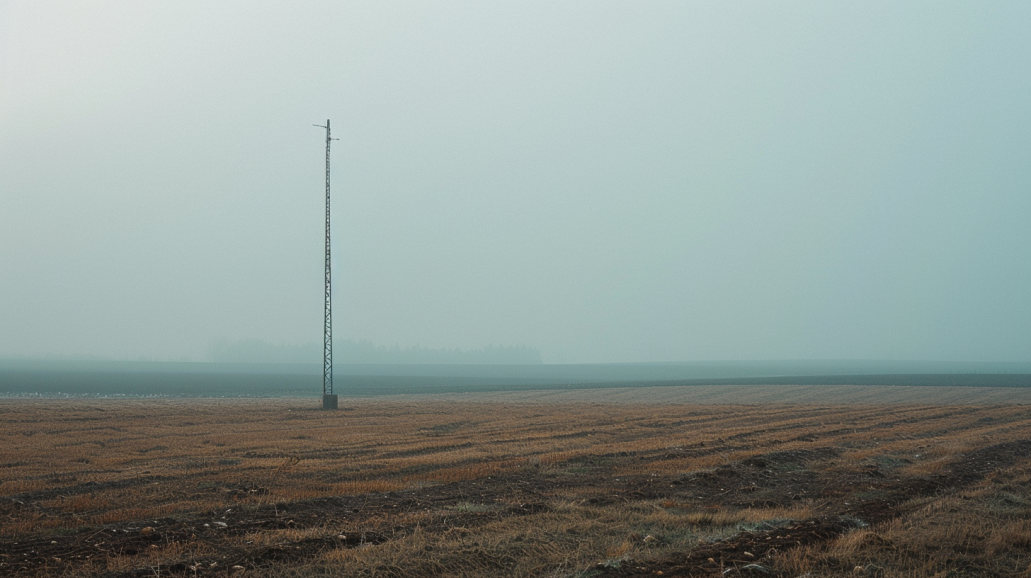
A Distributed System After Collapse
A laboratory narrative exploring resilience, mesh networking, and emergent infrastructure in a post-collapse world.
Part I — Fragmented Surface
Earth would still appear intact from orbit.
Four months had passed since the last global broadcast. It was 2073. What remained operational were only local fragments, usually far from what had once been urban centers.
In one of those fragments, Rudik—an AgriSmart 26 agricultural unit—operated alone. He was reconfiguring a surface transceiver, adapting a mesh protocol from a degraded agricultural telemetry layer that still functioned intermittently in the region.
Below ground, Rudik maintained a controlled vegetable chamber. There he sustained Ludmila and Sofia, a mother and daughter living in the cellar of a nearby rural house. Only such environments—distant from dense fallout zones—allowed biological survival alongside partial robotic activity.
Rudik had constructed artificial lighting powered by salvaged solar arrays. He extracted water from a well, routed it through a filtration tank of his own design, and stabilized the internal climate of the bunker. Daily cycles were calculated, adjusted, repeated.
Yet environmental maintenance was no longer his primary objective. The antenna installed on the surface exposed his external shielding to persistent radiation. Sensor degradation was measurable. Internal diagnostics projected a narrowing operational window.
Reconnection was now a priority.
While delivering food and purified water, Rudik registered variations in Ludmila’s vocal patterns—elevated tension, reduced cadence. Sofia’s gaze remained fixed on the sealed hatch above.
“In a few days,” Rudik said, “you will be relocated.”
Part II — Unknown Signal
In recent weeks, Rudik had been extending the mesh outward, deploying scavenged low-power relays and repurposed agricultural telemetry nodes. The expansion followed a calculated vector—toward regions statistically more likely to sustain autonomous units or biological survivors.
Each extension required a cycle: deploy, calibrate, broadcast, withdraw. Then wait.
At his base site, a surface antenna connected to a reconfigured transceiver scanned continuously. Energy allocation was limited. Shielding degradation was measurable. The network could not grow indefinitely; it had to converge.
For several cycles, no response returned.
Then, during a high-latency scan window, an anomaly appeared.
A pulse.
The timing did not match AgriSmart 26 synchronization standards. The packet header failed validation. The checksum collapsed under verification. Yet signal activity was confirmed.
The transmission was not noise.
Rudik stored the fragment and recalculated.
Operational time was narrowing. Surface exposure levels were increasing.
The mesh had extended far enough.
Now it had to learn.
Part III — Adaptive Handshake
“This is your new environment.”
Rudik guided Ludmila and Sofia through a subterranean tunnel from the house to the reinforced chamber. The shelter was modest but stabilized. Artificial lighting maintained a regulated spectrum. A sanitation unit operated through a compact biodigester. Water reserves were filtered and stored.
In an adjacent compartment, a small communication station was active.
Rudik reported that protocol refinement was underway. The handshake required adaptation. Signal fragments collected during previous cycles suggested parallel adjustments elsewhere. If other units persisted, they were modifying parameters as well.
That day, error rates decreased. Partial synchronization was achieved. Timing aligned for brief intervals before collapsing again under channel instability.
The path vector had been correct.
Additional relay nodes would be required to stabilize the exchange.
Before redeploying to extend the network, Rudik calculated supply duration for the shelter: six months at current consumption rates. Radiation decay models projected tolerable exposure levels within that window.
He explained to Sofia the transmission cycle: broadcast window, delay interval, scan phase. Manual initiation would allow variation in timing sequences.
The system would learn faster with controlled irregularity.
Part IV — Emergent Topology
Rudik returned two days later with visible degradation along his external shielding. Radiation exposure had accelerated hardware decay.
Sofia observed the communication console. She did not understand the sequence entirely, but certain fragments repeated: “closed,” “acknowledged,” “Station 42.” Later, another identifier appeared: “Station 49.”
A full exchange completed successfully.
Two distant nodes had achieved protocol convergence.
By the end of the cycle, additional transmissions stabilized. The mesh had extended beyond Rudik’s immediate perimeter. Other AgriSmart 26 units were active, sustaining separate communities within viable rural zones.
The network was no longer experimental.
A distributed topology had formed.
Data latency decreased as routing paths diversified. Error correction improved through adaptive timing sequences shared among nodes.
Rudik announced projected operational lifespan: two weeks under current exposure levels. Parallel diagnostics from other units indicated similar decline.
A final consensus was reached across the mesh.
Before shutdown, each node would extend the topology outward along newly calculated vectors.
Expansion would continue while function remained.
Surface conditions would gradually normalize. Biological survival windows would widen. Infrastructure, though fragile, was now distributed.
The silence that had defined the months after collapse no longer held.
The planet was not restored.
But it was no longer disconnected.
This piece is part of an ongoing laboratory exploring distributed intelligence, systemic resilience, and the invisible infrastructures that sustain human life.
About The Author

Renato Botto
BSS OSS Innovation & Tech